Cross-Laminated Timber: The Future of High-Rises
For centuries, wood was constrained by its natural dimensions. A tree only grows so tall, and a beam can only span so far before structural integrity compromises. The advent of mass timber, specifically Cross-Laminated Timber (CLT), has fundamentally disrupted structural engineering norms.
CLT consists of planks of sawn, glued, and layered wood, where each layer is oriented perpendicular to the previous. This cross-hatching of the natural grain neutralizes wood's tendency to shrink and swell along a single axis, creating large-scale panels with immense two-way span capabilities and compressive strength rivaling concrete.
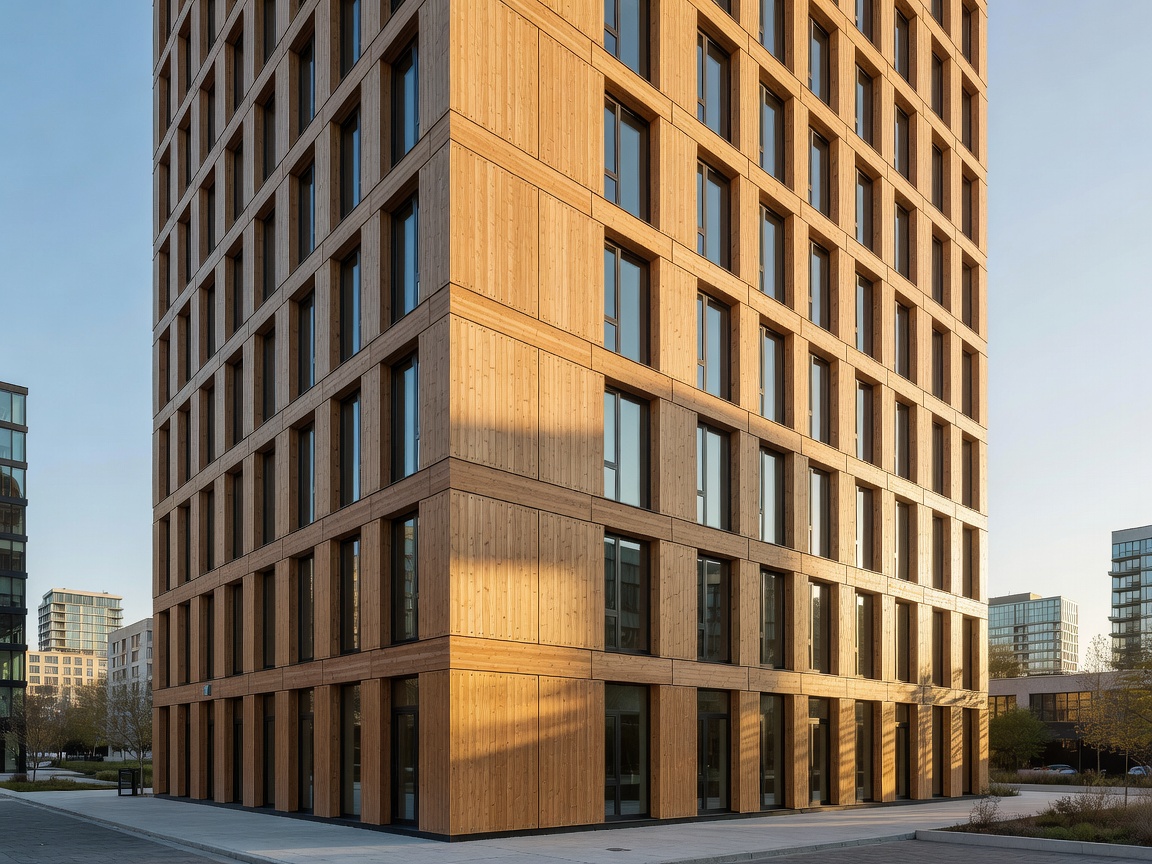
Glued Laminated Timber (Glulam)
While CLT dominates panelized construction (walls and floors), Glulam remains the reigning champion for columns and beams. By aligning the wood grain linearly rather than cross-hatching it, Glulam maximizes tensile and compressive strength along a single axis. It is frequently used for massive roof spans in arenas and large commercial spaces.
Fire Resistance and Charring
A common hesitation regarding wood high-rises is fire safety. However, mass timber exhibits exceptional fire resistance through a process called charring. When exposed to intense heat, the outer layer of a thick timber beam burns and turns to char. This char layer acts as natural insulation, protecting the inner core of the wood and maintaining structural integrity far longer than unprotected steel, which can quickly melt and warp under similar thermal stress.
Embodied Carbon Profiling
The primary driver for the adoption of structural timber in modern architecture is environmental. Cement production accounts for roughly 8% of global CO2 emissions. In contrast, trees sequester carbon as they grow. When harvested sustainably and locked into a building's structure, that carbon remains sequestered for the lifespan of the building, turning urban centers into vast carbon storage facilities.